St. Michael's Cathedral is an active Catholic cathedral and protected heritage building at 15 Zhejiang Road in Qingdao's Shinan old town. Visit for the twin-tower exterior and historic streets even if the interior is unavailable. Check the gate notice on the day for tourist entry, services, any admission charge, and photography rules: Masses, private ceremonies, preservation work, or parish needs can override a travel website's timetable.
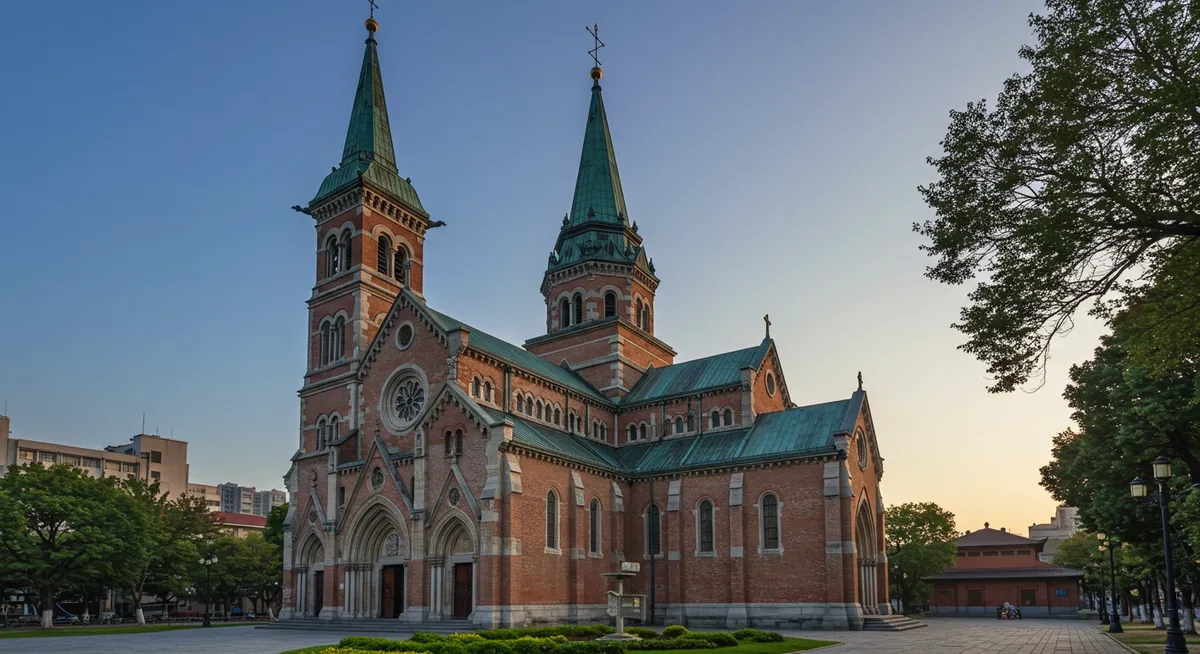
Best plan: make the cathedral one stop on an old-town walk rather than scheduling the whole day around interior access. Use Metro Line 1 to the Zhongshan Road area, approach on foot, check the posted rules, then continue to Zhanqiao or the Protestant Church and Signal Hill.
St. Michael's Cathedral at a Glance
Turn this guide into a personal route with our free Qingdao itinerary planner.
| Question | Reliable answer |
|---|---|
| Where is it? | 15 Zhejiang Road, Shinan District, Qingdao |
| What name works in Chinese maps? | 青岛天主教堂 or 圣弥厄尔大教堂 |
| What is it? | An active Catholic cathedral and nationally protected component of the Qingdao German Architectural Complex |
| When was it built? | Construction took place from 1932 to 1934 |
| Can tourists enter? | Only when the current parish, worship, heritage, and visitor arrangements permit |
| Are hours and tickets fixed? | No stable tourist timetable or price should be copied without same-day verification |
The Chinese name varies in English transliteration: official Qingdao pages use versions of St. Michael's, while maps may label it Zhejiang Road Catholic Church or Qingdao Catholic Church. Confirm the Zhejiang Road address rather than relying on the English name alone. The cathedral fits naturally into the old-city section of our Qingdao itinerary hub.
History: German Legacy, but Not a German Colonial-Era Building
Qingdao's official heritage record dates the cathedral to 1932–1934 and credits a German designer, whose name is rendered 毕娄哈 in Chinese. The design combines Romanesque and Gothic influences, while the official visitor description notes Italian Renaissance-style interior decoration.
Calling it a “German colonial cathedral” is imprecise. German administration in Qingdao had ended before construction began. The building belongs to the city's German missionary and architectural legacy, but it rose in the Republican period, not while the German colonial government controlled Qingdao. That timeline is more useful than the dramatic but poorly sourced stories repeated by tour pages.
The official Qingdao source records provincial heritage protection in 1992. In 2006, the cathedral was included in the nationally protected Qingdao German Architectural Complex. A city heritage list identifies the former name as St. Michael's Church and confirms the Zhejiang Road site. Qingdao's 2026 cultural-work plan also lists protection and repair work for the Catholic cathedral, another reason current access can differ from older visitor reports.
Competitor pages disagree on tower measurements, the designer's English name, interior capacity, organ details, and the claim that this is China's “only consecrated church.” Even Qingdao promotional pages use inconsistent tower heights. This guide therefore prioritizes the well-supported construction dates, location, mixed architectural style, religious function, and protected status rather than turning uncertain figures into visitor facts.
What to Look for Outside and Inside
The exterior
The front is organized around two symmetrical bell towers, a central entrance, a large rose window, red-tiled spires, and a strong vertical silhouette above the old-town streets. Official records describe a cross-shaped plan and reinforced-concrete structure. The facade reads as European church architecture, but it is not a textbook catalogue of every Gothic feature.
Walk to the lower end of the forecourt for the full twin-tower view, then move to one side for the relationship between the cathedral and Zhejiang Road. Wedding and portrait sessions are common in the surrounding public space. Do not step into a working shoot or photograph a couple closely without permission.
The interior, when open
The interior is a worship space, not a guaranteed museum display. Official descriptions mention the high central hall, religious paintings on the vault, altars, and Renaissance-influenced decoration. Stained glass, furnishings, lighting, and access to individual areas may change through restoration or liturgical use, so judge what is actually available rather than arriving with a checklist copied from an old page.
Do not assume the organ will be played, the bells will ring for visitors, or every chapel is open. Ropes, closed doors, covered artwork, or a request to remain at the rear should be treated as current operating rules.
How to Verify Visitor Access in 2026
Published third-party schedules conflict sharply. One competitor says weekends only; another lists a six-day tourist schedule; others publish different Sunday restrictions, Mass times, last-entry cutoffs, and ticket prices. None should be treated as a permanent parish notice.
- Check for a current notice at the Zhejiang Road gate. Look for separate information on tourist entry, liturgy, ticketing, restoration, and private events.
- Ask staff or an usher before entering. “参观?” means “visit?” and “可以拍照吗?” means “May I take photographs?” A translation app is useful.
- For Mass, use a parish or diocesan notice. Tourist ticket platforms are not worship authorities, especially for Christmas, Easter, Holy Week, or a patronal feast.
- Accept an exterior-only visit. A closed interior does not make the old-town stop a failure; the facade and surrounding heritage streets remain the main visual experience.
If an admission charge applies, pay only through the current official on-site channel and keep the receipt. Do not assume an online “skip-the-line” product represents cathedral admission. If a group visit or interior tour is essential, confirm it directly before travel rather than turning up with a large group.
Mass and Active-Church Etiquette
A service is worship, not an architectural tour. Non-Catholic visitors may be permitted to sit quietly, but admission and seating remain subject to the parish's directions. If you arrive as a service begins, ask an usher whether you may enter and where to sit.
- Silence your phone before entering and keep conversation for outside.
- Dress for an active church: choose clean, non-revealing clothing and remove a hat when requested.
- Do not circulate during Mass, approach the altar, enter roped areas, or turn worshippers into a photo backdrop.
- Do not photograph or record a service unless the parish explicitly authorizes it.
- Follow the congregation without imitation pressure: a visitor may remain seated or stand quietly if unsure when others kneel.
- Do not receive Communion merely as a visitor experience. Catholic sacramental discipline governs who receives it.
- Give priority to parishioners, funerals, weddings, and baptisms. Leave promptly if staff need the space.
Children are welcome only with close supervision appropriate to the service. Food, drinks, loud calls, fashion posing, and commercial photography belong outside. These practices protect both worshippers and the dignity of the heritage interior.
Photography Rules and Best Exterior Angles
Assume interior photography is prohibited until the current sign or staff says otherwise. If permission is granted, turn off flash, shutter sounds, autofocus lamps, and video lights. Do not use a tripod in an aisle or photograph individual worshippers. Permission on one visit does not create a permanent rule.
Exterior photography is more straightforward, but the forecourt can be crowded with wedding shoots, tour groups, and people queuing. Useful compositions include:
- a centered view from below the facade for the twin towers;
- a side angle that includes the sloping old-town street;
- a tighter frame of the rose window and upper facade;
- a contextual photograph with pedestrians small in the scene, taken without blocking them.
Overcast light controls contrast on the pale facade; clear light produces stronger shadows. After rain, paving may reflect the building but can be slippery. Drone use should never be improvised over a dense historic district or active religious site.
How to Get to St. Michael's Cathedral
Metro and walking
Metro Line 1 serves Zhongshan Road Station and Qingdao Station, making either useful for the old town. Zhongshan Road is the practical choice for approaching through the historic commercial streets; Qingdao Station works well when combining the cathedral with Zhanqiao. Use a live map for the best exit and walking line because historic-district construction and pedestrian routing can change.
The cathedral sits on a rise. Descriptions that place Little Fish Hill or Signal Hill “five minutes away” understate slopes and intersections. Wear shoes with grip, allow more time in heat or rain, and avoid building a tight transfer around the walk. See the Qingdao transport guide for metro and ride-hail basics.
Taxi or Didi
Use 青岛天主教堂, 浙江路15号 as the destination. Vehicle access at the forecourt may be limited by pedestrian crowds, ceremonies, or old-town traffic measures, so the driver may choose a nearby legal drop-off. Travelers with reduced mobility should ask for the closest safe entrance rather than a generic Zhongshan Road pin.
Build a Realistic Old-Town Walking Route
A compact route is Zhongshan Road area → St. Michael's Cathedral → Zhanqiao waterfront. It moves from the commercial old town to the cathedral and then toward the bay. Read the Zhanqiao Pier guide before adding the waterfront in peak weather.
For a steeper architecture route, continue from St. Michael's to the Qingdao Protestant Church and then Signal Hill. The two churches differ in denomination, date, form, and function; treat each as its own active or managed site. Add Little Fish Hill only if your time, weather, and walking ability support a longer hilly circuit.
On a first trip, the cathedral fits comfortably into the old-town day in our three-day Qingdao itinerary. Use the Qingdao itinerary planner to adjust the route around your hotel and walking tolerance.
Weather, Crowds, and Accessibility
The surrounding streets can be exposed, steep, wet, or congested. Summer heat and humidity make uphill walking harder; winter wind can be sharp; rain makes stone and paving slick. Carry water without drinking inside, and use sun or rain protection that can be folded away at the door.
Weekends, holidays, and popular wedding-photography periods bring the largest exterior crowds. Visit earlier in the day for a calmer facade view, but do not infer that an early arrival guarantees interior admission. During major Catholic observances, worship takes priority and tourist access may narrow even as the surrounding streets become busier.
Do not rely on claims that the entire route is flat, ramped, or equipped with accessible toilets. The old town has slopes and uneven transitions, while the church may have thresholds or restricted doors. Ask station staff for an accessible exit, use a precise vehicle drop-off, and confirm the entrance route with cathedral staff. An exterior-only plan is the safest fallback for travelers who cannot manage stairs or long slopes.
Authority Sources
- Qingdao Municipal Government: cathedral history, location, architecture, and heritage status
- Qingdao Cultural Heritage record: Qingdao German Architectural Complex
- Qingdao Municipal Government: 2026 architectural description
- Qingdao Culture and Tourism Bureau: 2026 cathedral protection-work plan
- Qingdao Metro: Line 1 Qingdao Station–Zhongshan Road section
- Catholic Church in China: 2026 General Instruction of the Roman Missal material
Frequently Asked Questions
Where is St. Michael's Cathedral in Qingdao?
It is at 15 Zhejiang Road in Shinan District's old town. Search for 青岛天主教堂 or 圣弥厄尔大教堂 and confirm the Zhejiang Road address.
Can tourists enter St. Michael's Cathedral?
Tourist entry may be available outside services, but it is not guaranteed. Check the current gate notice and ask staff because Masses, private ceremonies, preservation work, or parish needs can close or restrict the interior.
What are the cathedral's opening hours and ticket price?
Published travel pages conflict, and hours or charges can change. Verify the same-day on-site notice and use only the current official sales channel rather than relying on an old timetable or reseller.
Can non-Catholics attend Mass?
They may be allowed to sit quietly if the parish admits visitors. Ask an usher, remain at the designated place, do not tour or photograph during worship, and do not receive Communion as a visitor experience.
Can you take photographs inside?
Assume no until the current sign or staff grants permission. Never photograph a service without explicit authorization, and avoid flash, video lights, shutter sounds, tripods in aisles, or identifiable worshippers.
Which metro station is best for the cathedral?
Line 1's Zhongshan Road Station is practical for the historic-center approach. Qingdao Station is another option when combining the cathedral with Zhanqiao. Use live navigation for the current exit and uphill walking route.
Was St. Michael's Cathedral built during German colonial rule?
No. It was built from 1932 to 1934, after German administration in Qingdao had ended. German missionary and architectural influence is important, but “German colonial-period cathedral” gives the wrong construction timeline.
Is St. Michael's Cathedral wheelchair accessible?
Do not assume a fully step-free visit. The old-town approach has slopes and uneven transitions, and the operating entrance may change. Confirm an accessible metro exit, vehicle drop-off, and church entrance before traveling.