Direct answer: Zhanqiao Pier is a worthwhile 45–75 minute introduction to Qingdao's old-town waterfront. Walk from the Zhongshan Road end toward Huilan Pavilion, pause around the breakwater for bay views, then return to the shore. Check wind, crowd controls and pavilion notices before committing: an open waterfront does not guarantee that the full pier or pavilion interior is accessible.
2026 planning note: build the visit around the outdoor pier and pavilion exterior. We found no current authoritative source confirming a permanent daily timetable, ticket price or guaranteed interior exhibition for Huilan Pavilion. Treat any staffed interior access as an optional on-the-day bonus.
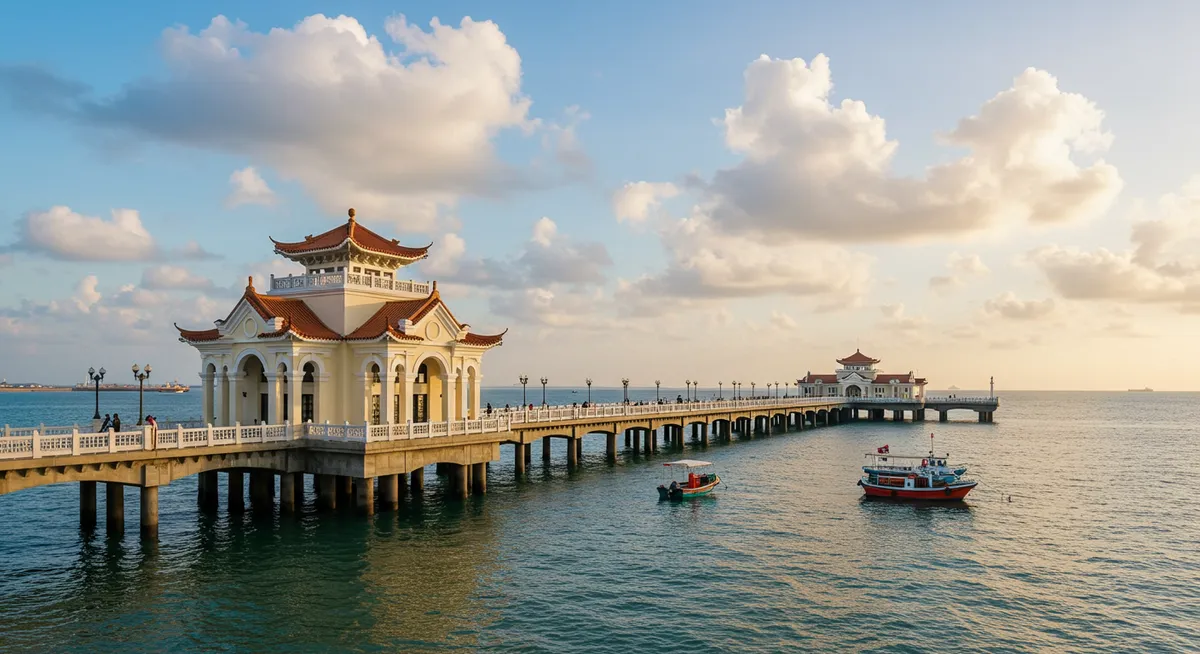
Zhanqiao Pier Visit Plan at a Glance
Turn this guide into a personal route with our free Qingdao itinerary planner.
The attraction works best as a simple out-and-back walk. The time bands below include pauses and crowd friction rather than claiming an exact walking duration.
| Time | Stop | What to notice | Live decision |
|---|---|---|---|
| 0–10 min | Bridgehead on Taiping Road | Look south toward the pavilion, then back north along Zhongshan Road to understand the old-town axis. | Read notices and observe barriers, waves and crowd flow before entering. |
| 10–30 min | Pier approach | Compare the sheltered bay side with the more exposed water and watch the city view widen behind you. | Turn back if the surface is slick, the wind is uncomfortable or staff restrict movement. |
| 30–45 min | Breakwater and Huilan Pavilion exterior | Observe the double-eave octagonal form and the pavilion's relationship to the semicircular breakwater. | Enter only if a current staffed notice explicitly confirms access and its conditions. |
| 45–75 min | Return and shore viewpoint | Use the beachfront or Taiping Road side for the full pier-and-pavilion composition. | Stay on signed public surfaces; low tide is not permission to walk onto slippery rocks. |
If this is your first stop after arriving by train, it fits neatly into the Qingdao itinerary hub. Keep luggage at your accommodation or an official storage facility rather than trying to manage bags on a crowded, exposed pier.
Verified History of Zhanqiao and Huilan Pavilion
Qingdao's official scenic-site history dates Zhanqiao to 1892 at the south end of Zhongshan Road. It began as a 200-metre-long, 10-metre-wide pier. During the German occupation, it was extended to 350 metres and carried a light railway for transport.
A major municipal reconstruction began in 1931. The official record says the pier was extended to 394.38 metres, its deck raised by 0.5 metres, and a semicircular breakwater added at the southern end. A two-storey, double-eave octagonal pavilion was built inside that breakwater and named Huilan Pavilion (回澜阁, often written “Huilange”). A 2026 Qingdao Government account says the reconstruction was completed on July 1, 1933.
Zhanqiao and Huilan Pavilion are protected municipal cultural relics. That is why this guide treats them as a historic structure first and a photo backdrop second: railings, closed doors, repair zones and staff directions protect both visitors and the site.
Why many guides give a different length and date
Many commercial pages repeat a 440-metre current length and an 1891 origin. Qingdao's own heritage page instead gives 1892 and records 394.38 metres after the 1931 reconstruction. Measurement boundaries and later shoreline work may explain some variation, but the official historical figures are the defensible ones. Exact length is not needed to plan the visit.
What not to assume about Huilan Pavilion
The pavilion is easy to appreciate from the surrounding pier when that section is open. Do not assume its interior, upper floor, exhibitions or panoramic viewing level will be available. Commercial listings frequently publish fixed hours, fees and exhibit descriptions without linking to a current operator notice. Check the staffed entrance or bridgehead visitor information on arrival.
Current Access, Hours and Fees
Zhanqiao is an open-air waterfront attraction, but “open-air” does not mean guaranteed 24-hour access to every section. High waves, strong wind, icing, maintenance, events or crowd management can change the usable route. Follow barriers and staff even when a map app describes the attraction as open.
- Pier access: confirm the day's access at the bridgehead. Do not bypass a temporary barrier.
- Pavilion access: check the current entrance notice for hours, last entry, capacity and any fee.
- Advance booking: do not buy a generic “Zhanqiao ticket” merely because an aggregator labels the page as ticket inventory. Verify what the product actually includes.
- Services: toilets, vendors, visitor help and luggage facilities should be located in a live map or confirmed locally; their precise hours can differ from pier access.
For a low-stress visit, arrive with the outdoor walk as the complete experience. This removes the need to force a closed pavilion or wait in a dense queue.
How to Get to Zhanqiao Pier
| Method | Best approach | What to verify |
|---|---|---|
| Metro | Use Line 1 or Line 3 to Qingdao Station, then follow a live pedestrian route toward the waterfront. | Station exit, road crossings and temporary works can change; use current signs rather than a saved exit number. |
| Train arrival | The pier can be a first or last old-town stop from Qingdao Railway Station. | Store bags first and leave a buffer for station security and platform access. |
| Bus | Search a live transit app for stops around Taiping Road or Qingdao Station. | Do not rely on a long static route list; services and stop patterns change. |
| DiDi or taxi | Use the public bridgehead or a legal Taiping Road drop-off as the destination. | Heavy visitor traffic may make a nearby walk faster than insisting on the closest pin. |
| Private car | Check live parking availability in the old-town area before departure. | Do not assume roadside or pier-adjacent spaces will be available. |
Our Qingdao transport guide explains metro payment, ride-hailing and navigation basics. It is more reliable to route to “栈桥” in a current China-compatible map than to follow an old English bus list.
Best Time to Visit: Light, Weather and Crowds
Morning versus late afternoon
Early morning often gives more space and a cleaner line along the pier, but sunrise color is never guaranteed. Late afternoon can produce warmer light on the pavilion and old-town facade, but it also tends to concentrate visitors. Midday is perfectly workable when the goal is history rather than dramatic light.
Check the hourly forecast, visibility, wind and rain—not just the daily temperature. The pier is exposed and has few ways to escape sudden weather. Overcast conditions can be better for facade detail; fog may hide the bay but create atmospheric close views.
Wet, windy or icy conditions
Salt spray, rain and winter ice can make surfaces slippery. Wear shoes with grip, secure hats and loose equipment, and keep both hands available near crowded sections. If waves cross the walking surface, lightning approaches or staff begin clearing the pier, leave promptly. The shore view still provides a complete visit.
Seagull Season Without the Hype
Zhanqiao is strongly associated with Qingdao's winter seagull season. Recent official programming ran through winter into March, and Qingdao held a spring-migration event in late March 2026. That supports winter to early spring as the most realistic viewing window, not a guaranteed November-to-April schedule or a promised number of birds.
Bird presence varies with migration, food, weather, tide and crowding. Observing and photographing without feeding is the simplest option. If current local signs and staff permit feeding and you choose to participate, follow the official guidance, never offer spoiled food, clean up packaging and crumbs, and do not crowd the rail or step toward the water for a closer shot. The city's safety guidance specifically warns visitors to watch the edge and congestion while feeding birds at coastal sites.
Photography: Reliable Angles and Honest Expectations
- Bridgehead view: use the straight pier line to lead the eye toward Huilan Pavilion.
- Shore profile: step onto a signed public waterfront area for the full side-on structure. Do not walk onto wet rocks to copy a social-media angle.
- Return view: photograph north toward Zhongshan Road to show how the pier connects the bay with the old town.
- Breakwater detail: frame the octagonal pavilion and double eaves without assuming interior access.
- Elevated context: pair the visit with Xiaoyushan or Signal Hill for a broader city-and-bay perspective, subject to their live access and visibility.
Tripods, commercial shoots and staged portraits may be affected by crowd-control or venue rules. Use handheld equipment during busy periods, keep the route clear and ask staff before setting up anything that occupies public space.
Accessibility, Children and Waterfront Safety
Mobility access
The main approach is comparatively direct, but this page cannot guarantee a fully step-free visit. Crowds, temporary barriers, surface transitions, weather and the pavilion threshold or stairs can create obstacles. A wheelchair user may still enjoy the shore viewpoint or part of the pier; confirm the current route with onsite staff before proceeding to the far end.
Visiting with children
Keep children within arm's reach near railings and in dense crowds. Do not let them climb the structure, chase birds or run onto exposed shore surfaces. A short bridgehead visit is a better fallback than pushing tired children to the far end in heat, wind or rain.
Water access
Zhanqiao is a pier visit, not a managed swimming plan. Do not enter the water from the structure or assume an adjacent patch of sand has supervised bathing service. For designated options and current safety checks, use our Qingdao beach guide.
What to Pair with Zhanqiao Pier
Two- to three-hour old-town route
Start at Zhanqiao, then walk north along the Zhongshan Road axis toward St. Michael's Cathedral. Continue only as far as your pace and the weather allow. This route protects the pier's role as an introduction rather than forcing it into a full-day attraction.
Half-day viewpoint route
Combine the pier with one hill viewpoint, not both, and leave time for transit and any ticketed access. Browse our things to do in Qingdao guide for alternatives when fog or wind makes the waterfront less rewarding.
Food stop
Walk into the old town instead of buying the first unpriced seafood offered beside a major attraction. Confirm the menu, portion and total before ordering; the Qingdao food and drink guide explains local dishes and ordering basics.
Plan Your Zhanqiao Pier Stop
Choose a realistic time window, check the live weather and transport route, and decide whether the pier is a standalone waterfront stop or the start of an old-town walk.
Build a Zhanqiao Pier itinerary
Authority Sources and Live Checks
- Qingdao Government: Zhanqiao heritage overview — official location, 1892 origin, historical dimensions, reconstruction and protection status.
- Qingdao Government: 2026 Zhanqiao history feature — military-pier origin and the 1931–1933 reconstruction chronology.
- Qingdao Government: seagull-feeding safety guidance — food and crowd-edge precautions.
- Qingdao Government: 2026 spring seagull migration event — current seasonal context.
- Qingdao Metro: current operations — verify Line 1 and Line 3 service before travel.
Zhanqiao Pier FAQ
Is Zhanqiao Pier open 24 hours?
Do not rely on a permanent 24-hour promise. Zhanqiao is an open-air attraction, but weather, maintenance, events and crowd controls can restrict the full pier. Check the bridgehead notice and obey barriers when you arrive.
Do I need a ticket for Zhanqiao Pier?
Plan the outdoor pier walk without buying a generic attraction ticket. Any current fee may relate to a specific pavilion interior, exhibit, tour or commercial product. Verify exactly what is included at the staffed entrance before paying.
Can visitors go inside Huilan Pavilion?
Interior access is not guaranteed. View the pavilion exterior as the core visit, then check the day's posted entrance, hours, last-entry time, capacity and photography rules. A commercial listing marked “open” may refer to the wider pier rather than the pavilion.
How long should I spend at Zhanqiao Pier?
Allow 45–75 minutes for the bridgehead, out-and-back pier walk, pavilion exterior and shore viewpoint. Add time for dense crowds or confirmed pavilion access; shorten the visit when wind, rain, waves or mobility needs make the far end uncomfortable.
Which metro station is closest to Zhanqiao Pier?
Qingdao Station on Metro Line 1 and Line 3 is the practical rail stop. Use station signs and a live map for the best current exit and pedestrian crossing rather than relying on an old exit number.
When can I see seagulls at Zhanqiao Pier?
Winter into early spring is the strongest recent official seasonal signal, but birds and migration timing are never guaranteed. If feeding is currently permitted, follow posted guidance, never use spoiled food, remove litter and stay back from crowded edges.
Is Zhanqiao Pier wheelchair accessible?
Part of the outdoor approach may be usable, but a fully step-free route is not guaranteed. Crowds, temporary barriers, surface conditions and pavilion stairs or thresholds can be limiting. Confirm current conditions with onsite staff and use the shore viewpoint as a fallback.